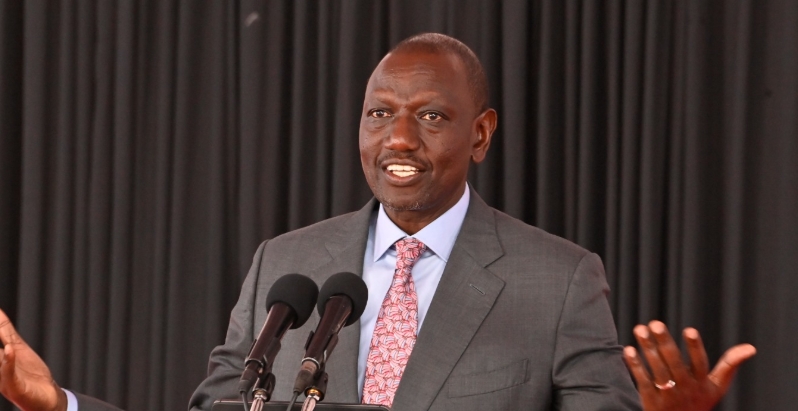
- President William Ruto linked Raila Odinga’s legacy to electoral participation during the handover of Raila’s mausoleum in Bondo.
- Ruto defended his political cooperation with Raila and described the broad-based government as part of their commitment to national unity.
- The President cited roads, housing, healthcare and other government programmes as areas reflecting Raila’s development priorities.
- The mausoleum is expected to form part of a larger memorial complex featuring a library, museum and research centre.
- Raila Odinga died in India on October 15, 2025, aged 80, and was buried at Kang’o Ka Jaramogi in Bondo.
President William Ruto has used the handover of Raila Odinga’s mausoleum in Bondo, Siaya County, to reflect on the late former Prime Minister’s political legacy, while urging Kenyans to take part in the electoral process.
Speaking during the official dedication ceremony on Wednesday, October 7, Ruto connected voter registration with Raila’s long-standing calls for electoral reforms and political participation. He said every eligible Kenyan should have an opportunity to register and participate in choosing the country’s leaders.
The ceremony comes days before the first anniversary of Raila’s death and has brought together members of the Odinga family, government officials and invited guests. The mausoleum at Kang’o Ka Jaramogi has now been formally handed over following the completion of the first phase of the memorial project.
Ruto said Kenyans who fail to participate in elections would be missing an important part of the democratic principles associated with Raila’s political career.
The President presented voter participation as one of the issues Raila consistently championed during his decades in public life. He said eligible citizens should make use of their constitutional right to choose their leaders.
The message added a political dimension to an otherwise commemorative ceremony, coming at a time when preparations are underway for the first anniversary of Raila’s death. Raila remained one of Kenya’s most influential political figures until his death in October 2025.
Ruto also revisited his political relationship with Raila and defended the decision by the two leaders to work together after the political tensions of 2024.
The President said Raila had supported national unity and believed leaders should place the interests of the country ahead of political competition. Their cooperation was later formalised through a 10-point framework covering areas such as the National Dialogue Committee recommendations, inclusion in governance and the protection of devolution.
Ruto argued that the partnership was built around issues affecting the country rather than individual political interests. He also sought to connect his administration’s development programmes with principles he said Raila had advocated during his political career.
Among the programmes highlighted by Ruto were major road and transport projects planned for different parts of the country.
He pointed to the proposed extension of the Standard Gauge Railway from Naivasha through Kisumu to Malaba and the planned Isiolo-Mandera highway. He also highlighted the Lake Victoria Ring Road, which the government says will cover about 500 kilometres and link Busia, Siaya, Kisumu, Homa Bay and Migori. Construction is scheduled to begin in November 2026.
The President has previously described the road as an important link for communities and economic activities around Lake Victoria. The project is expected to improve movement between lakeside communities, markets and other economic centres.
Ruto further cited affordable housing, healthcare programmes and government support targeting older people, farmers and young entrepreneurs. He presented these initiatives as part of a wider development agenda focused on expanding opportunities across the country.
Mausoleum to Preserve Raila’s History
The new mausoleum forms part of a wider effort to preserve the history of Raila and his father, Jaramogi Oginga Odinga.
Ruto said the five-sided design of Raila’s mausoleum was deliberate and was intended to evoke the ODM Pentagon coalition associated with the 2007 political period. The structure also stands next to the six-sided mausoleum of Jaramogi, who was Kenya’s first Vice President.
The National Museums of Kenya has listed the complex for protection as part of the country’s national heritage. Construction was overseen during the final stages by the Ministry of Defence, working alongside museum technical teams.
The government has also outlined plans for the next phase of the memorial, which is expected to include a library, museum and research centre. The facility is intended to preserve archives and material relating to Kenya’s political and democratic history.
The site is also expected to develop into a heritage attraction for visitors to Siaya and the wider Nyanza region. The government says such activity could support tourism and create economic opportunities around the area.
Raila Died in October 2025
Raila died on October 15, 2025, while receiving medical treatment in Kochi, India. He was 80 years old at the time of his death.
His body was later returned to Kenya before he was buried beside his father at Kang’o Ka Jaramogi in Bondo. The location has since been developed into a larger memorial site dedicated to preserving the history of both leaders.
The October 7 handover comes exactly eight days before the first anniversary of Raila’s death. Public access to the mausoleum is scheduled to begin on October 8, while further memorial activities are planned for later in the month.