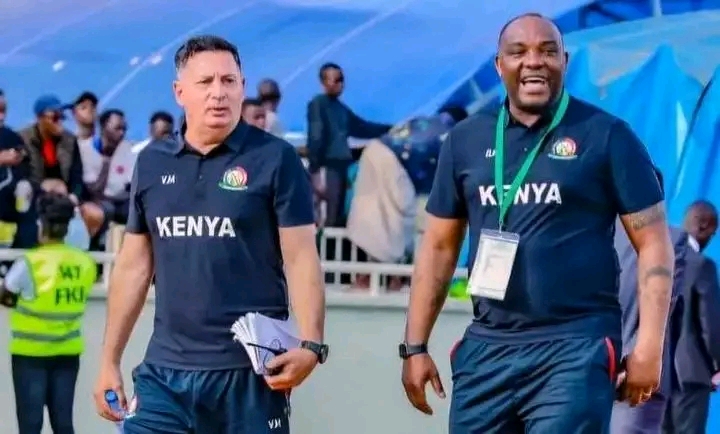
- Benni McCarthy has overseen Harambee Stars during a period that includes the 2025 CHAN campaign and the opening stages of AFCON 2027 preparations.
- His reported record after 20 matches stands at eight wins, five draws and seven defeats, according to the supplied performance brief.
- Player selection, domestic scouting and the coach’s work-permit concerns have emerged as areas requiring clearer explanations.
- McCarthy has also publicly spoken about his desire to return to club management after his Kenya contract.
- Kenya is already guaranteed a place at AFCON 2027 as a co-host, making the current competitive matches important preparation opportunities rather than qualification contests.
Benni McCarthy’s tenure as Harambee Stars head coach is entering an important phase, with Kenya preparing for the 2027 Africa Cup of Nations on home soil. The South African coach has now been in charge long enough for his results, player selections and technical approach to be examined against measurable expectations.
Kenya’s position is also unusual. The country is automatically qualified for AFCON 2027 as one of the three hosts, but the national team is still participating in the qualifying campaign. CAF says the matches provide McCarthy with an opportunity to build and assess his squad ahead of the finals.
That situation makes performance assessment less about qualification and more about how effectively the technical team is building a side capable of competing when the tournament arrives.
According to the supplied performance data, McCarthy’s first 20 matches in charge produced eight wins, five draws and seven defeats. That gives him a 40 per cent win rate across the period covered by the brief.
The same record shows Kenya scoring 33 goals and conceding 33. The figures should be read alongside the competitions and opposition involved rather than treated as a standalone measure of coaching performance.
Kenya’s strongest tournament showing under McCarthy cited in the brief was a quarter-final appearance at the 2025 CHAN tournament. The team’s latest AFCON 2027 qualifying match against Eritrea ended 1-1 in Nairobi. CAF confirmed that result on September 26.
Previous Coaches Offer Useful Benchmarks
Historical comparisons can provide context, although they should not be treated as definitive rankings because match-counting methods and the competitions involved can differ.
Sébastien Migné’s tenure provides one measurable reference point. Kenya qualified for the 2019 AFCON finals under the French coach, returning to the tournament after a 15-year absence.
That achievement gives stakeholders a concrete outcome against which periods of national-team management can be discussed. It does not, by itself, establish that one coach was better or worse than another.
The relevant question for the current technical team is therefore what measurable progress Kenya should expect between now and AFCON 2027.
McCarthy’s squad-building approach has attracted attention throughout his tenure. The supplied brief records dozens of players being called up and a sizeable number receiving playing time, while some established and emerging players have also been left outside particular squads.
In September, FKF confirmed a 38-man provisional squad for the AFCON 2027 qualifiers before McCarthy reduced it to a final 24. The squad included players based in Kenya and abroad, with several younger players receiving opportunities.
The issue for accountability is not whether every omitted player should have been selected. It is whether the technical team can clearly explain the criteria being applied.
After more than 18 months in charge, stakeholders can reasonably ask whether McCarthy has established a stable core, a preferred tactical structure and consistent principles for selecting players.
McCarthy’s concerns about his work-permit status have also raised questions about how he monitors domestic football.
In September, the coach said he and members of his foreign technical staff had been working without the required permits and that the situation meant they left Kenya after national-team assignments. He linked his limited presence in the country to difficulties watching domestic matches and scouting players consistently. FKF responded to the concerns surrounding the permit process.
The administrative issue and the scouting question are related but should not be confused.
If the head coach cannot remain in Kenya between international camps, there should be a clearly documented alternative system. That could include named scouts, regular domestic match reports, video analysis, performance data, regional scouting assignments and scheduled player-assessment meetings.
The important accountability question is therefore not simply whether McCarthy has been physically present at local matches. It is how the technical team ensures that players performing well in the domestic league are identified and assessed.
Another issue that deserves clarity is McCarthy’s publicly stated desire to return to club management.
In March 2026, he said the Kenya experience had been valuable but that the limited time available with a national team was frustrating him because he preferred working with players every day. He said he was looking to return to club management after his Kenya experience.
Those comments do not establish that he lacks commitment to Harambee Stars.
They do, however, create a legitimate continuity question for FKF. What arrangements are in place if a suitable club opportunity emerges before the end of his Kenya contract?
That question becomes particularly relevant as Kenya moves closer to AFCON 2027 and seeks continuity in its technical preparations.
Allegations Need Evidence Before Conclusions
Some claims circulating around the national team concern alleged meetings between McCarthy and political figures, as well as claims about restrictions on media access.
Those matters should not be presented as established facts without independent corroboration.
For any alleged meeting involving McCarthy and former football administrator and politician McDonald Mariga, the basic questions are whether the meeting occurred, when and where it happened, who attended and what was discussed.
The same standard should apply to allegations that particular media personnel were excluded from press conferences or denied access to team transport. If such restrictions occurred, the relevant questions would include who authorised them, what policy was applied and whether there was a documented security, accreditation or operational reason.
Until independently verified, these should remain allegations rather than assertions.
With AFCON 2027 approaching, the national-team discussion can move beyond individual opinions and focus on measurable technical issues.
Among the questions stakeholders can reasonably ask are:
- What is McCarthy’s preferred starting XI when the main players are available?
- What objective criteria determine selection?
- How many domestic matches has the technical team attended since taking charge?
- How many players have entered the national-team setup through domestic scouting?
- What scouting system operates when the foreign technical staff are outside Kenya?
- What is the technical pathway for building the AFCON 2027 squad?
- What targets were set for CHAN, World Cup qualification and AFCON preparation?
- How does the technical team assess its results after 20 matches?
- What changed after McCarthy said he would reduce experimentation with selections?
- What arrangements protect continuity if the coach receives a club offer before AFCON 2027?
- What formal procedures govern communication between the coach and FKF leadership?
- What rules govern media access to the national team?
These questions do not require a predetermined judgment about the coach. They provide a framework for measuring the work being done.
AFCON 2027 Changes the Standard
Kenya’s automatic qualification means the immediate objective is not securing a place at the tournament. CAF has explicitly described the qualifying fixtures as an opportunity for McCarthy to develop and assess his squad ahead of the finals.
That gives the technical team a clear window to establish a competitive core, test tactical options and assess players before the tournament begins.
The public-interest test should therefore be measurable: results, player development, selection consistency, domestic scouting, tactical identity, preparation and professional communication.
With AFCON 2027 being hosted in Kenya, Tanzania and Uganda, the period leading to the tournament provides the technical team with time to demonstrate how those areas are being addressed.
The most useful debate now is not whether McCarthy should be labelled a success or failure. It is whether FKF and the technical bench can show, with evidence, how Harambee Stars are progressing towards the demands of AFCON 2027.