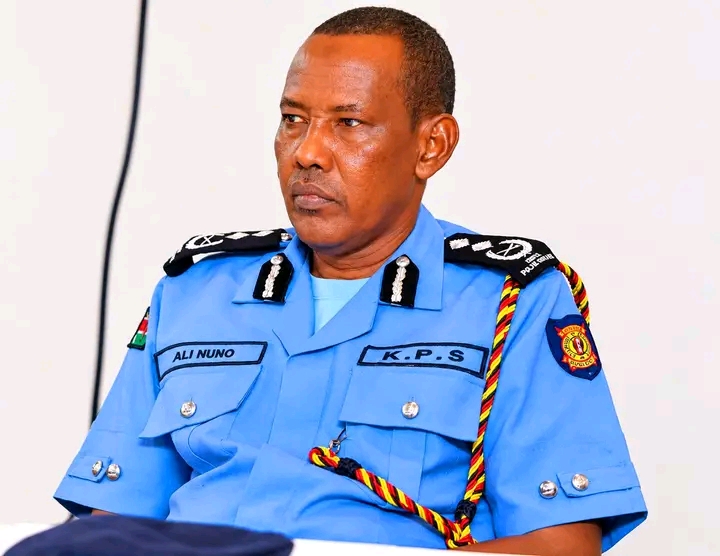
- Ali Nuno Dubat has served in several senior police command positions during a career spanning more than three decades.
- He gained national attention during his time as Kayole OCPD when Nairobi’s Eastlands faced insecurity linked to the Gaza gang.
- He became Coast Regional Police Commander in January 2025 after serving as Kwale County Police Commander.
- He was among 51 senior officers promoted to Assistant Inspector-General of Police in March 2025.
- His approach to tackling machete-wielding gangs at the Coast attracted criticism from the Kenya National Commission on Human Rights over the use of firearms.
Assistant Inspector-General of Police Ali Nuno Dubat has built a career around frontline security operations, taking up command responsibilities in some of Kenya’s challenging policing environments.
His name became widely recognised during his time as the Officer Commanding Police Division in Kayole, Nairobi, where he dealt with the threat posed by the Gaza gang. The criminal group had been associated with violent robberies, attacks on residents and confrontations with law enforcement officers in parts of Eastlands.
Nuno adopted an approach that combined efforts to persuade young people to abandon criminal activities with firm police operations against those who continued engaging in violence. Reports about his time in Kayole describe initiatives encouraging gang members to surrender illegal weapons, alongside operations targeting the group’s criminal networks.
His work during that period contributed to his growing profile within the police service. He was later awarded the Order of the Grand Warrior (OGW) on December 12, 2018, in recognition of his service.
After his Kayole assignment, Nuno continued serving in several locations, including Thika, Kiambu and Murang’a. His postings placed him in areas where police were dealing with organised crime, insecurity and other public safety challenges.
He also served as Murang’a County Police Commander, a position he held during the period surrounding the January 2023 Kandara parliamentary by-election. In early 2024, he briefly moved to the National Police Service headquarters, where he served as Director of Corporate Communications.
His next major field assignment took him to Kwale County, where he served as County Police Commander. His responsibilities included addressing security threats and criminal networks in the region.
In January 2025, changes within the National Police Service saw him appointed Coast Regional Police Commander, taking charge of security operations across the coastal region. His elevation was followed by a promotion to Assistant Inspector-General of Police in March 2025, placing him among the senior officers recognised in the police service’s promotion exercise.
Soon after taking over the Coast command, Nuno attracted attention for an unusual inspection at Kisauni Police Station.
On February 3, 2025, he visited the station disguised as a member of the public reporting a robbery. He wanted to assess how officers handled complaints from ordinary residents.
According to accounts of the incident, officers at the station initially failed to record his complaint promptly and did not offer the assistance he expected. He later identified himself and confronted the officers over their handling of the report.
His experience at Kisauni contrasted with a visit to Nyali Police Station, where officers reportedly received him professionally and recorded the complaint without similar difficulties.
The exercise highlighted his emphasis on police responsiveness and accountability, with the commander using the incident to challenge officers to improve their treatment of members of the public.
Nuno’s approach to organised crime at the Coast came under national scrutiny in February 2026 following a warning to machete-wielding gangs operating in parts of Mombasa, Kilifi and Kwale.
On February 7, he told suspected gang members to abandon criminal activities or leave the region, adding that officers would use firearms where the law justified it. His remarks came amid reports of violent robberies targeting residents and businesses.
The statement triggered a strong response from the Kenya National Commission on Human Rights. KNCHR called on the police leadership to clarify the directive, arguing that the use of force must remain within constitutional and human rights safeguards.
The debate placed Nuno’s tough public stance against violent gangs alongside wider concerns about police accountability and the protection of civilians.
His command has also been associated with multi-agency security operations targeting criminal networks and drug trafficking along the Coast. These efforts have included arrests and seizures during operations in the region.
Nuno has also taken a firm position on the relationship between politics and insecurity, particularly as Kenya approaches the 2027 General Election.
In July 2026, he warned coastal politicians against recruiting criminal gangs or using violence to disrupt public order. He stressed that security agencies would act against anyone found engaging in such activities and called for police operations to remain free from political interference.
His remarks reflected concerns about the possible use of gangs during political mobilisation and the importance of maintaining stability across the region.
Nuno’s public profile has continued to grow because of his direct communication style and the high-profile security operations associated with his postings.
Supporters of firm enforcement see his approach as an attempt to confront criminal groups and demand better service from officers. His statements on the use of firearms, however, have also attracted criticism from human rights organisations, keeping the question of lawful policing at the centre of debate.
From his years in Kayole to his leadership role at the Coast, Nuno has remained a prominent figure in Kenya’s security sector. His record is likely to continue attracting attention as police operations, public safety and accountability remain major issues across the country.