- President William Ruto has called on financial institutions to lower the cost of credit and make financing more accessible.
- The President said the average lending rate stood at 14.39 per cent in July despite the Central Bank Rate falling to 8.75 per cent.
- Ruto said economic stability should now support investment, business expansion and job creation.
- He defended monetary and fiscal measures taken after economic pressures experienced in 2022.
- The President also highlighted growth in financial access and called for stronger regulation of emerging financial technologies.
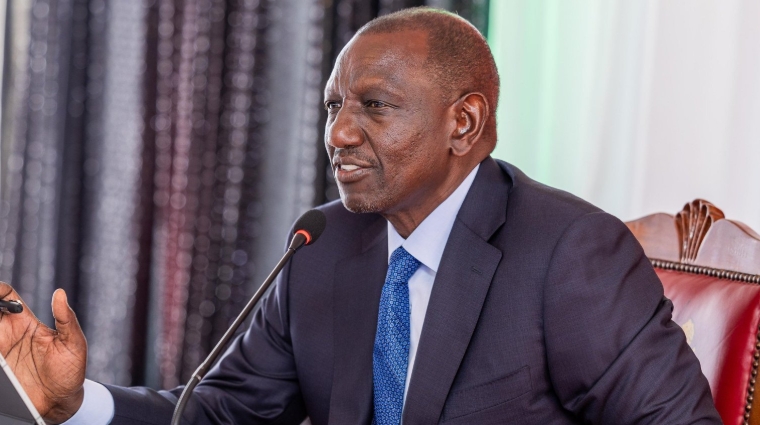
President William Ruto has challenged Kenya’s banking sector to make credit more affordable, saying the country’s improved economic stability should now translate into increased investment and business activity.
Speaking in Nairobi during celebrations marking 60 years of the Central Bank of Kenya, Ruto said lending costs remained high despite the easing of monetary policy. He said households, farmers, businesses and young entrepreneurs needed better access to financing if the economy was to generate more investment and employment.
The CBK currently has its Central Bank Rate at 8.75 per cent after retaining the rate at its August 11, 2026 meeting. The average commercial bank lending rate stood at 14.39 per cent in July, according to CBK data.
Ruto said the next stage of Kenya’s economic programme should focus on turning financial stability into wider economic activity.
“Stability is not prosperity. It is the foundation on which prosperity must be built,” Ruto said.
Ruto said the reduction in the Central Bank Rate had been followed by a decline in lending rates, but argued that the cost of borrowing remained a challenge for many Kenyans.
“The Central Bank Rate now stands at 8.75 per cent. Lending rates have declined, but at 14.39 per cent in July, credit remains expensive for many Kenyans and their businesses,” he said.
CBK data shows that the average commercial bank lending rate has been gradually falling, from 14.81 per cent in January to 14.39 per cent in July. The July figure was also significantly below the 17.2 per cent recorded in November 2024.
The President said banks should play a greater role in financing productive sectors of the economy rather than simply maintaining strong balance sheets.
“Kenya does not need strong banks merely for the sake of having strong banks. We need strong banks capable of financing a strong economy,” he said.
The President also used the occasion to defend the monetary and fiscal measures adopted after Kenya faced significant economic pressures in 2022.
He pointed to high inflation, rising food and energy costs, pressure on the shilling and expensive international borrowing as some of the challenges that shaped the government’s response.
According to Ruto, the CBK responded by tightening monetary policy while the government worked on fiscal pressures, including the 2024 Eurobond maturity. He acknowledged that the measures increased borrowing costs and involved difficult fiscal decisions, but said they helped improve key economic indicators.
CBK data currently shows foreign exchange reserves at about $15.25 billion, equivalent to 6.3 months of import cover. The bank also reported August 2026 inflation at 6.6 per cent and said the banking sector remained stable with strong liquidity and capital adequacy.
Ruto also highlighted the expansion of formal financial access over the past two decades.
He said access had risen from 26.7 per cent of Kenyan adults in 2006 to 84.8 per cent in 2024, with mobile money and digital financial services playing a major role in the expansion.
The President said the focus should now move beyond simply bringing more people into the formal financial system. He wants financial access to translate into the ability of households to build financial security and businesses to obtain funds for expansion.
The remarks come as CBK continues to report stronger growth in private-sector credit. The central bank said lending to the private sector grew by 10.2 per cent in July 2026, compared with negative growth recorded in January 2025.
Ruto Calls for Regulation of Emerging Financial Technologies
The President also called for secure regulation of artificial intelligence, digital assets and emerging payment technologies.
He said regulation should protect public confidence while allowing financial innovation to continue developing. The remarks come as Kenya’s financial sector increasingly relies on digital platforms and new technologies to deliver services.
At the continental level, Ruto called on African central banks to deepen financial integration and make cross-border payments faster and cheaper.
He said Africa holds more than $4 trillion in assets across banks, pension funds, insurance companies and capital markets, arguing that greater mobilisation of these resources could support infrastructure, agriculture, manufacturing and technology.
The Central Bank of Kenya was established in 1966 after replacing the East African Currency Board. It took responsibility for Kenya’s monetary policy and financial stability and has since become a central institution in the country’s financial system.
Ruto reaffirmed the importance of the bank’s independence, describing it as an important part of Kenya’s economic framework.
“The independence of the Central Bank is therefore not an abstract constitutional principle. It is part of Kenya’s economic strength,” he said.
The anniversary comes as the CBK continues to balance inflation management, exchange-rate stability, credit growth and financial-sector resilience.